Customer support
Customer asks for a manager: how the agent keeps the conversation
Do not defend the rules and do not transfer at once. Repeat what the customer wants, say what you can do now, and if a manager must join, hand over the facts so the customer does not tell the story again.
 Kristina RohovynskaCMO, SoftTrainer
In short
- Find out why the customer wants a manager. Usually they think the manager can give more, or that you cannot help.
- Say what you can do. "I cannot" and "I am not authorised" invite the request for a manager.
- Give agents the same yes as managers. If the manager would agree, the agent must be able to agree too.
- Hand over the facts with the call. A manager who knows the story saves the customer from repeating it.
A customer calls a broadband provider for the third time about the same wrong bill. Two minutes in, he says: "Put me through to your manager." The agent answers: "I am sorry, my manager is not available."
Now the customer is sure that this agent cannot help. A request for a manager means one thing: the customer wants someone who can decide. This article is part of our guide to difficult customer conversations in sales and support.
Find out why the customer wants a manager
In our experience, customers ask for a manager for two reasons. They believe the manager can give more, or they feel that the agent cannot solve the problem. Ask one question to find out which: "What would you like the manager to do?"
Gene Reynolds of Blackchair says in Call Centre Helper that some customers think a manager gives quicker and better service. Many say so openly. In a survey by Walnut for Twilio of 2,000 GB adults in July 2022, 47% said they would ask to speak to the manager to speed up the resolution. The second reason often starts with the agent’s own words.
On many occasions, I find that an escalation call is created by the advisor’s responses, such as ‘I cannot fix that’ or ‘I am not authorised to do that’.
Say what you can do now
Replace each "I cannot" with what you can do now. The customer then hears a person who acts, and the reason to ask for someone else gets weaker. Repeat the request in the customer’s words first, so they know you heard it.
| Instead of | Say |
|---|---|
| "I cannot change the bill." | "I can open a correction now and send you the reference number." |
| "I am not authorised to do that." | "I can offer a credit of up to one month today. For more, I will get the decision by 3 pm." |
| "My manager is not available." | "You want the bill fixed this week. Let me tell you what I can do right now." |
| "Please hold" (and a transfer) | "My team lead will call you back by 3 pm. She will already know the details." |
If the manager would say yes, let the agent say yes
Many requests for a manager come from a team rule. If a manager gives what an agent refused, customers learn to escalate. Agree in advance what an agent can offer and keep managers to the same line.
Brian Cantor of CCW Digital calls this the biggest problem of escalation: asking for a supervisor works.
If you force your agents to say no, do not provide a “yes” when the customer escalates.
When a manager must join, hand over the facts first
Some calls need a manager: a decision above the agent’s limit, a legal threat, or a customer who will not talk to the agent. Then pass the facts before the manager speaks. A transfer without the facts makes the customer repeat the story and get angry again.
Gene Reynolds of Blackchair advises in Call Centre Helper never to pass the call straight through. Tell the customer that a manager will call back in the next few minutes, and keep that promise.
- Repeat the request. "You want the bill fixed this week and a credit for the two wrong months."
- Say what you can do now. "I can open the correction and add one month of credit today."
- If it is not enough, name the next person and the time. "My team lead decides on the second month. She will call you by 3 pm."
- Hand over the facts. Write the account, the request, what you offered and the customer’s mood in three lines.
The opposite view: customers want an easy way to a person
Twilio argues for the opposite: make the way to a person easy at any point. Its data supports this. In Twilio research of August 2026, 63% of consumers wanted an easy way to escalate at any point, and only 47% of brands gave them one.
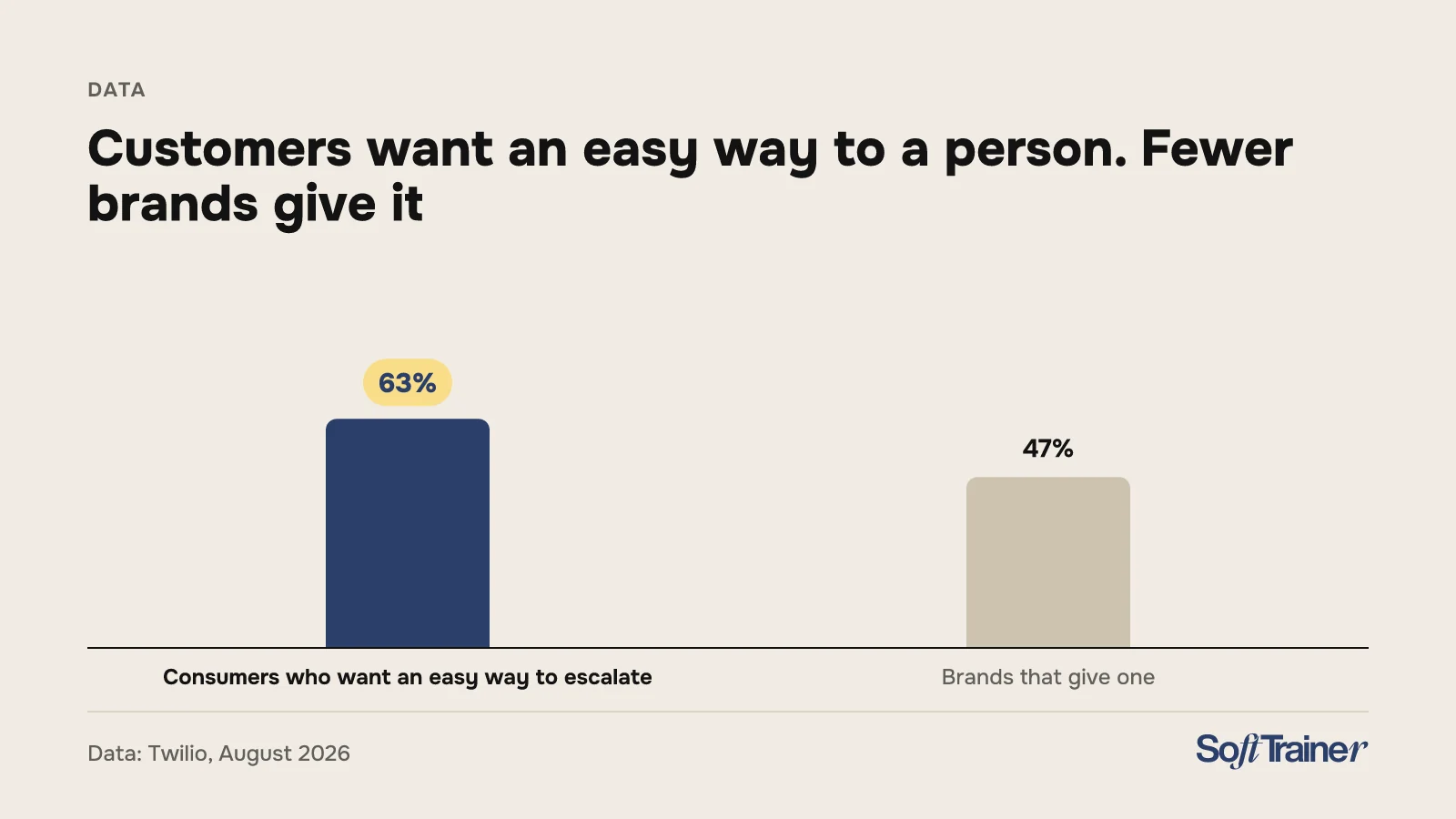
We agree that the way to a person who decides must be easy. Most of the Twilio data is about escaping a bot. With a human agent, the fastest route to a decision is often the agent, if the agent has the authority. When a manager must join, the handover above keeps the route short.
For the team lead: check how agents handle the request
You will rarely hear this moment in a random sample of calls. In a pilot, a European IoT security company assessed 11 support agents in realistic conversations with an AI customer. 89% of them had critical skill gaps that manual review had not shown.
Support and Trust was one of the four competencies scored. It covers exactly this moment: the customer doubts that the agent can help.
The request for a manager often comes after a bad start, so train the opening too: how to talk to an angry customer. In sales, the same pressure comes as a price objection: how to answer "too expensive" without a discount.
What to do tomorrow
Write down what an agent in your team can offer without a manager: credits, dates, exceptions. Then ask two managers what they gave in their last five escalations. Where the lists differ, change the rule or the manager’s answer.
Questions and answers
What should an agent say when a customer asks for a manager?
Repeat what the customer wants and say what you can do now. If the customer still wants a manager, name the person and the time of the call back, and hand over the facts.
Should an agent refuse to transfer a customer to a manager?
No. Refusing makes the customer angrier. Offer what you can do first, and if a manager must join, arrange it with a clear time and a summary of the case.
Why do customers ask for a manager so often?
They believe that a manager can give more, or they feel that the agent cannot help. Phrases like "I cannot" and "I am not authorised" make the second feeling stronger.
How do you reduce escalations in a support team?
Give agents the authority that managers use, and keep managers to the same rules. Then train the phrases that show what an agent can do, and check them on one scale.
Sources
- Robyn Coppell: How to Handle Escalation Calls (Call Centre Helper, 2018, updated 2026)
- Brian Cantor: If Customer Service Agents Have To Say No, Their Supervisors Better Not Say Yes (CCW Digital, 8 August 2022)
- Twilio: Why 78% of customers try to bypass your AI agent (27 August 2026)
- Startups Magazine: Can I speak to the manager? (Twilio and Walnut Omnibus survey, July 2022)
- Надія Гайдай-Грузевич: Як чути своїх клієнтів? Налагоджуємо роботу служби підтримки (The Page, 16 вересня 2025)
- SoftTrainer case study: support team assessment at a European IoT security company