Measurement
Kirkpatrick model: the four levels and where it breaks for soft skills
The Kirkpatrick model evaluates training on four levels: reaction, learning, behavior and results. Most teams stop after the first two, and for a soft skill the hard part is Level 3.
 Ruslan KovalenkoCo-founder and CEO, SoftTrainer
In short
- Four levels. Reaction, learning, behavior and results. Each level answers a different question about the same training.
- Most teams stop at Level 2. In an ATD survey, about half measured behavior and fewer measured business results.
- A soft skill breaks Level 2. A quiz shows what a person knows about feedback. It does not show how the person gives it.
- Measure the conversation. The same scenario and the same scale before and after the training give you Level 3.
A head of L&D reports to the CEO after a leadership programme: a high score on the survey, and almost everyone completed the course. The CEO asks one question: "Do our managers talk to their people differently now?" The report has no answer.
The Kirkpatrick model exists for that question. This article explains the four levels and shows where they fail for communication skills. It is part of our guide to AI roleplay for soft skills training.
The Kirkpatrick model has four levels of evaluation
The Kirkpatrick model is a way to evaluate training on four levels: reaction, learning, behavior and results. Donald Kirkpatrick described it in the 1950s, and Kirkpatrick Partners keeps the current version. Each level answers its own question.
| Level | Question | Usual tool | For a soft skill |
|---|---|---|---|
| 1. Reaction | Did people find the training relevant? | Survey after the session | The same survey works |
| 2. Learning | Did people get the knowledge and the skill? | Quiz, test | A quiz shows knowledge only. The skill needs a conversation |
| 3. Behavior | Do people act differently at work? | Follow-up survey, observation | A scored conversation in the same scenario, before and after |
| 4. Results | Did the business number move? | Sales, retention, complaints | The same numbers, compared with the levels of the team |
Kirkpatrick Partners advise planning from the top: start with Level 4 and the reason for the programme, then go down. Decide what result you want before you choose the training.
Most teams stop at Level 2
Most organizations measure reaction and learning, and far fewer measure behavior and results. In a survey of 779 talent development professionals by ATD in 2019, about eight in ten organizations used Levels 1 and 2. Only 54% measured Level 3, 38% measured Level 4, and 16% measured Level 5, the financial return.
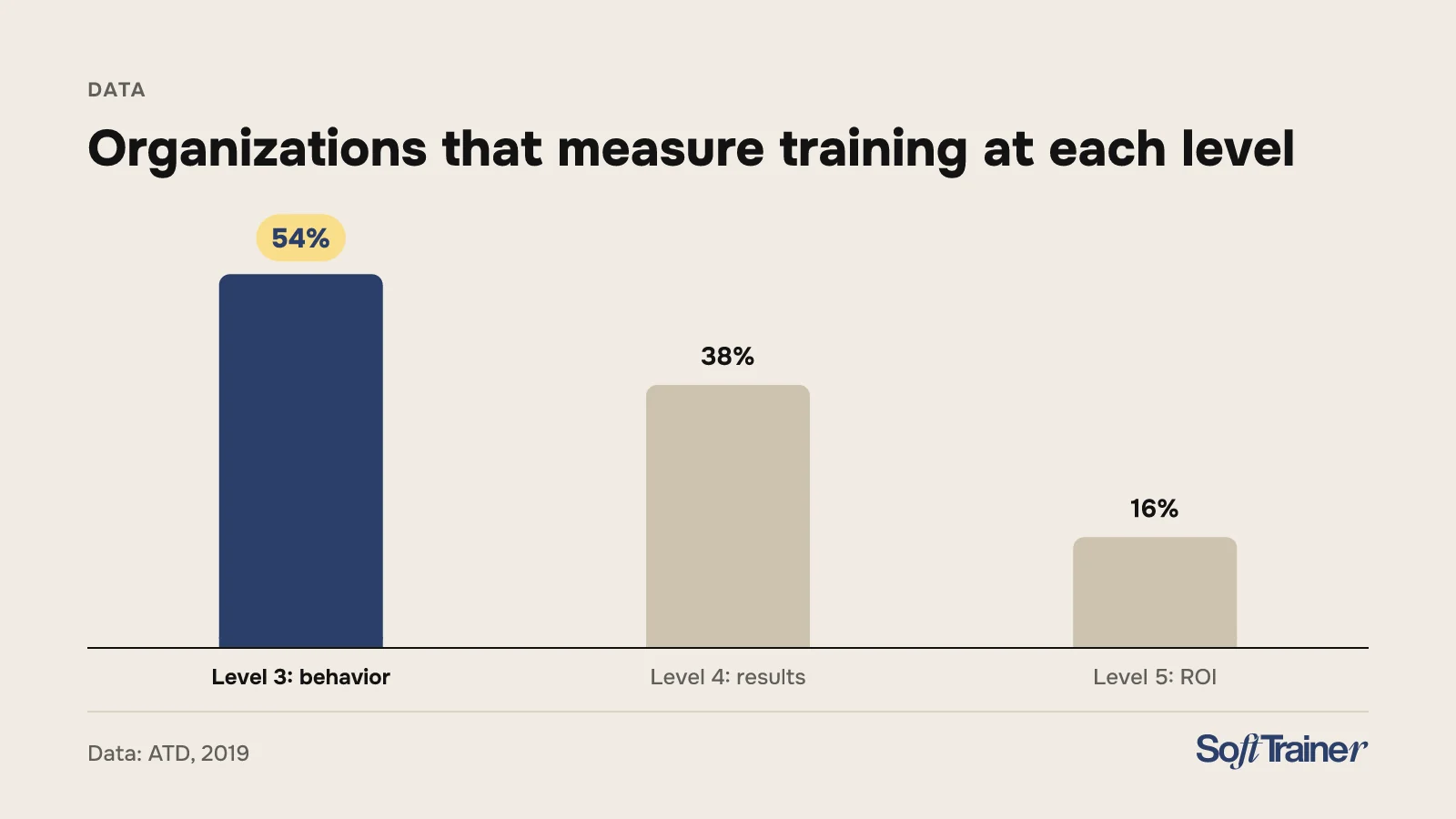
Teams skip Levels 3 and 4 for a practical reason. In the same ATD survey, 41% of respondents said that the top barrier was to isolate the effect of a programme on results. Our own research shows the same wall. In 130+ interviews with HR and L&D leaders from October 2024 to March 2026, about 25% said that they cannot measure the ROI of training.
For a soft skill, the model breaks between Level 2 and Level 3
A test can show that a manager knows the steps of a feedback conversation. It cannot show that the manager stays calm when the employee disagrees. For a soft skill, knowledge and behavior are two different measurements, and most Level 2 tools measure only the first.
Will Thalheimer, a learning researcher and the author of the LTEM evaluation model, names this as the main weakness of the four levels. Level 2 holds everything from the recall of facts to real skill.
But when you put it all in one bucket, people tend to default to the lowest common denominator.
Level 3 has its own problem. The usual tools are a follow-up survey and the opinion of the manager. Both are opinions, and soft skills feedback is subjective: two managers give the same conversation different marks.
The opposite view: replace the model
Thalheimer argues that the four levels send L&D teams the wrong way, and he offers eight tiers in their place. His evidence against Level 1 is strong. In the same interview he cites two meta-analyses in which survey scores correlate with learning results at 0.09.
That means if you get high marks in your smile sheets, you could have a good course, you could also have a bad course.
We agree about the survey and we keep the four levels. Executives know them, and the four questions are the right questions. What must change is the tool for Levels 2 and 3. Thalheimer himself says in the interview that the model has good points: it reminds L&D about behavior change and results.
How SoftTrainer measures Level 2 and Level 3 for a conversation skill
In SoftTrainer, each person talks by voice to an AI character in a situation from real work. In one public scenario the manager tells Daniel Mercer, a senior engineer, that his peer got the promotion. The manager must say the decision plainly, own what was promised and agree a path.
The report gives a level for each competency, with evidence from the conversation. The whole team gets one scenario and one scale, and one assessment takes ten minutes for each person. After 90 days the team does a new assessment, and each competency shows one step up, one step down or no change. That change is your Level 3 number.
Kirkpatrick Partners warn that the check of behavior must start earlier than 90 days after the training. The practice runs between the two assessments do this work: each run ends with one next step. Our methodology describes the cycle, and one rule matters here: practice between assessments does not move the level.
What to do tomorrow
Take one programme that you plan for the next quarter. Write one sentence for each level, starting with Level 4: the business number, the behavior that moves it, the skill behind the behavior, and the survey question about relevance.
If you cannot name the behavior, do not buy the training yet. For the money side, use the training ROI calculator and its formula.
Questions and answers
What are the four levels of the Kirkpatrick model?
Level 1 is reaction: did people find the training relevant. Level 2 is learning: knowledge and skill. Level 3 is behavior at work. Level 4 is results for the organization.
Which level of the Kirkpatrick model is the hardest to measure?
In the ATD survey of 2019, the top barrier was to isolate the effect of training on results. For soft skills, Level 3 is hard because the usual tools are opinions.
Is the Kirkpatrick model still relevant?
Yes, as a set of four questions. Critics such as Will Thalheimer show that surveys and knowledge checks tell little about skill. Keep the levels and use a better tool for Levels 2 and 3.
How do you measure Level 3 for communication skills?
Give each person the same realistic conversation before the training. Check behavior in the first weeks after it, as Kirkpatrick Partners advise, and repeat the full assessment after about 90 days. Score both assessments with one scale. The change in the level of each competency is the behavior result.
Sources
- Kirkpatrick Partners: What is the Kirkpatrick Model?
- Shauna Robinson: L&D’s Struggle With Learning Evaluation (ATD, 6 December 2019)
- Robin Hoyle: Learning-Transfer Evaluation Model with Will Thalheimer (Huthwaite International, 6 June 2023)
- Станіслав Омельченко: «А давайте проведемо навчання...» (HURMA, 7 травня 2021)
- Anna Liashenko: Корпоративне навчання, яке працює: три принципи (DOU, 4 травня 2021)
- Laba: 5 типових проблем корпоративного навчання (13 серпня 2021)
- Kovalenko, R., & Rohovynska, K. (2026). The Soft Skills Measurement Gap. Zenodo