Tension reduction: the skill behind every hard conversation
De-escalation is a small set of moves that you can hear in a conversation, so it can be measured and trained. What it sounds like, what the research says, and what we saw when a support team was assessed on it.
Picture this: your company charged a bakery owner twice for the same order. Her card bounced at her supplier, and she waited 22 minutes to reach support. The agent’s first sentence decides the next ten minutes. “I understand your frustration, but our policy says five to seven working days” is technically correct. It also makes her louder.
It is a good test of tension reduction, the skill under every hard conversation, with a customer or with two colleagues who stopped talking.
What de-escalation is
De-escalation is what you do so that the other person can think about the problem again instead of defending themselves. Katelyn Carey, an acute care nurse who has handled thousands of emotionally charged conversations over 25 years, explains the most common mistake:
But the second we tell someone to calm down, all we've really done is prove that we don't understand their threat.
In practice, the skill is five moves you can hear:
- You do not tell the person what to feel (“calm down”, “there is no need to shout”).
- You name the fact and what is at stake for them: “You were charged twice and your supplier payment bounced.”
- You ask what worries them most, and you repeat the answer in their words.
- You give an honest time and do not promise what you cannot keep.
- You end with one next step that both of you can repeat.
Carey adds that you do not need to win:
You don't have to agree with the person. You don't even have to fix the problem.
Why knowing the moves is not enough
Front-line staff need de-escalation often. In the Institute of Customer Service analysis of June 2025, 43% of UK customer-facing workers had experienced customer hostility in the previous six months.
Jeremy Pollack, a social-organizational psychologist and workplace conflict resolution expert, wrote in Training Industry on 13 November:
But knowing what to do and being able to do it under pressure are two different things.
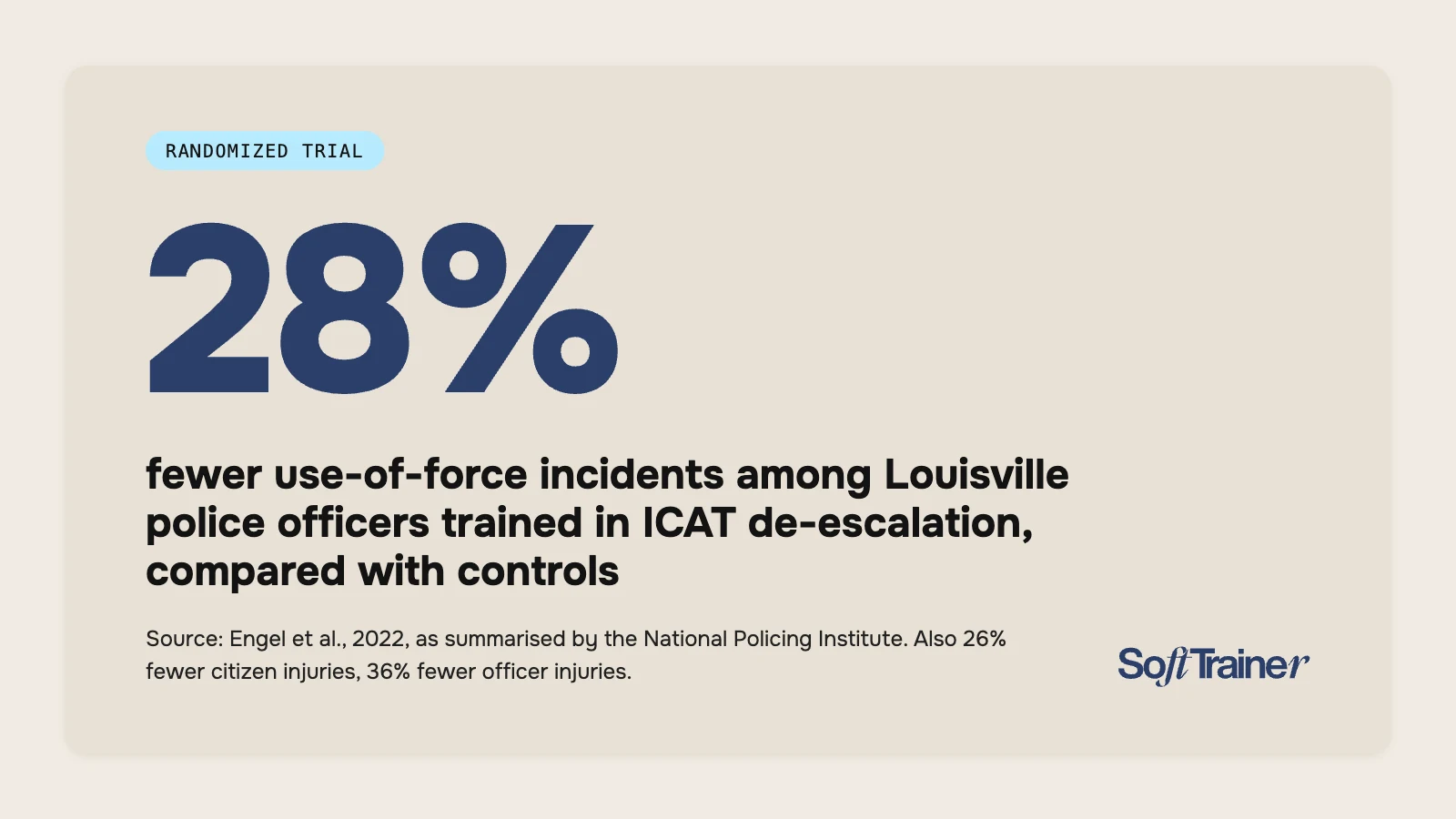
The strongest evidence I found that training changes behaviour comes from policing. In a randomized trial of the ICAT programme in Louisville, Kentucky, trained officers had 28% fewer use-of-force incidents than controls, 26% fewer citizen injuries and 36% fewer officer injuries, as the National Policing Institute summarises.
The opposite view
A RAND Europe review for NHS England found that de-escalation training may not in itself reduce violent or aggressive incidents, and that the evidence is mixed. A second randomized trial, in Virginia Beach, found better officer interpersonal skills but no change in how often force was used, as the National Policing Institute reports.
A one-day course is not a fix, and RAND itself notes that frequent training and refresher sessions help. Our answer is to measure the skill before and after practice instead of counting attendance. We do not yet have data on whether workplace incidents go down after it.
What we saw in a pilot
A European IoT security company with more than 3,000 employees assessed 11 customer support agents. Each agent had a voice conversation with an AI customer in a realistic situation, such as an angry customer or a technical complaint. We scored four competencies, and Tension Reduction was scored apart from Problem Solving.
According to the case study, assessment took 10 minutes per person instead of about 60. 89% of the agents had critical skill gaps that manual review had not shown. After the pilot, L&D targeted three things: paraphrasing, response structure and trust-building. Each of them is a move you can repeat in the next call.
What to do tomorrow
Write down the three sentences you say when a conversation gets hot. Check each one: is it about the person or about the problem?
- Instead of “calm down”: “I can see this matters a lot. What worries you most right now?”
- Instead of “that’s our policy”: “Here is what I can do today, and here is what I can’t.”
- Instead of “I’m sure it’ll be fine”: an honest time and the date when you will come back.
After your next hard conversation, give yourself one score: did it end with one next step that both of you could repeat?
Sources
- TEDxPortsmouth: The secret to de-escalating angry people, Katelyn Carey (YouTube, 16 July 2025)
- Training Industry, Jeremy Pollack: Training Leaders to Manage Conflict on Their Teams (13 November 2026)
- National Policing Institute: Slowing It Down: How De-escalation Is Changing Policing
- RAND Europe: Reviewing the evidence base for de-escalation training: a rapid evidence assessment (2019)
- Institute of Customer Service: Service with Respect, standalone offence (27 August 2025)
- DOU: Що робити, якщо менеджер токсичний, і як конфлікти вирішують в українських ІТ-компаніях (30 липня 2024)
- People First Podcast, епізод 49: Як розрулити конфлікт: роль менеджера, медіатора (YouTube, 24 листопада 2025)
- SoftTrainer case study: How a European tech leader cut assessment time by 66%
Ruslan Kovalenko, Co-founder and CEO, SoftTrainer