How to resolve a conflict between two employees: a 5-step plan for managers
When two employees fall out, start with a private conversation with each of them. A joint meeting comes later, and sometimes you do not need it. Here are five steps and the first sentence for tomorrow.
A support team lead with eleven agents. Two senior agents disagree about who owns escalated refund tickets. One of them now forwards every refund case to the other with a one-line note. The other leaves them in the queue until the end of the shift. Customers wait.
The usual move is to call both into one room and ask them to sort it out. That is fast, and it often makes the conflict worse. Neither person is ready to listen, and the manager does not know yet what the dispute is about.
Step 1. Two private conversations, no verdict
Meet each person alone first. Ask open questions, and talk about what you saw: the forwarded tickets, the notes, the queue times. Do not decide who is right.
Bob Bordone, a Senior Fellow at Harvard Law School who founded its Negotiation and Mediation Clinical Program, gives managers a short rule for this meeting:
But if you are the boss or supervisor, avoid taking a side.
Step 2. Check whether the cause is the people at all
Liz Kislik, a management consultant, argues in her TEDx talk that we blame people for problems that sit in roles, goals and decision rights:
It seems unrealistic to blame individuals and to treat them as if they have sole responsibility for conflict, when as you can see, they're really only the tip of the proverbial iceberg.
Her example: two executives with overlapping responsibility fought for a year. HR tried to broker a truce. Nothing changed until the leader who caused the overlap left and the roles were redefined. I agree with her. In our support team, the first question is simple: who owns an escalated refund? If nobody wrote it down, fix that before any joint meeting.
The opposite view: mediation may not be your job
Bordone himself warns managers against stepping in too fast:
Just because your employees are asking you to intervene in their dispute and to mediate, doesn't mean that it's a good idea, or your job to do so.
I agree with half of this. The private conversations of step 1 are always the manager’s job. The joint conversation is not always yours to run. If you have a long history with one of them, an outside mediator is the better choice.
Step 3. Decide whether you can run the joint conversation
Bordone asks managers to check three things before they mediate. Can I be fair to both? Will both see me as fair? Do I have the skills, temperament and time?
If any answer is no, bring in HR or an outside mediator. Bordone says he is always impressed by managers who make this call (3:04).
Step 4. Run the joint conversation from interests to an agreement
- Agree on ground rules: each person speaks without interruption, and nobody attacks the other person.
- Each person describes the situation and what matters most to them.
- You restate demands as interests. "I will not take refund tickets" becomes "I need a clear limit on escalations per shift".
- Both people list options without judging them, then choose the ones that meet both interests.
This follows the path that an Acas-commissioned study found in informal resolution: from each person’s own view, to a shared understanding, to agreed next steps. The study is based on 33 interviews with managers and practitioners.
Step 5. Test the agreement and book the follow-up
When the two say they are done, do not close the meeting yet. Read back each interest and ask if the agreement meets it. Then book a check-in in two weeks, first with each person and then together.
Disputes take hours of leaders’ time
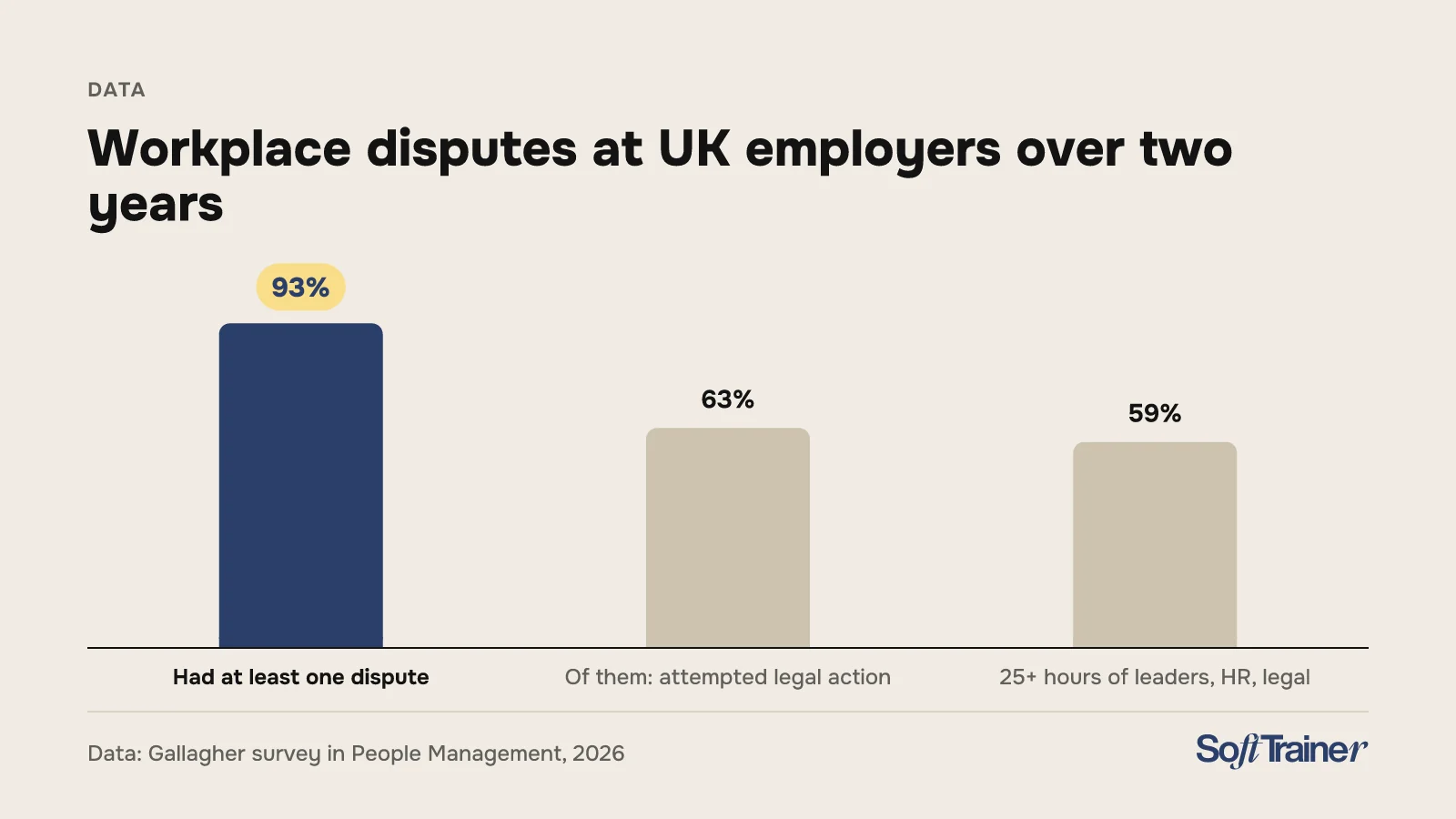
A Gallagher survey of 501 UK employers found that 93% dealt with at least one workplace dispute in two years. Of those, 63% saw attempted legal action, and 59% of employers spent at least 25 hours of senior, HR or legal time on disputes.
The same Acas study names a key barrier: managers lack the skills and confidence for informal resolution. Our research of 130+ interviews with HR and L&D leaders points the same way. In about 21% of them, leaders said that what people learn does not reach their behaviour at work. A manager can know these five steps and still freeze when one agent raises their voice.
What to do tomorrow
Pick one pair on your team where you see tension. Write down three things you saw yourself, with no judgement. Book two private 20-minute conversations.
Open each one with: "Since last week, I see escalated tickets moving between you two with one-line notes. I want to understand how this looks from your side. I am not here to decide who is right."
Sources
- People Management: Nine in 10 employers have faced workplace disputes, survey finds (3 November 2026)
- Acas, The Social Agency: Defining and enabling informal workplace conflict resolution (30 June 2025)
- Bob Bordone: How to Mediate A Conflict Between Two Employees (YouTube, 1 April 2022)
- Liz Kislik: Why There’s So Much Conflict at Work and What You Can Do to Fix It, TEDxBaylorSchool (YouTube, 16 January 2018)
- People First Podcast, епізод 49: Як розрулити конфлікт: роль менеджера, медіатора (YouTube, 24 листопада 2025)
- Devlight, Оксана Крикун: Ефективна комунікація в команді. Вирішення конфліктів (YouTube, 10 квітня 2024)
- Артем Бородатюк: Комунікація, що веде до реалізації. Фреймворк CBI (Telegram, 16 листопада 2026)
- Kovalenko, R., & Rohovynska, K. (2026). The Soft Skills Measurement Gap. Zenodo.
Ruslan Kovalenko, Co-founder and CEO, SoftTrainer