Sales
"We will think about it": 12 answers by the reason for the pause
When a customer says "we will think about it", find the reason for the pause before you answer. Below are 12 questions in 4 groups by the reason: no urgency, no authority, no trust and no budget. Close each answer with a date.
 Kristina RohovynskaCMO, SoftTrainer
In short
- Most reps let the customer go. A Ukrainian mystery-shopping test of 124 sales teams heard "okay, thanks" and "we will wait" as the usual answer.
- Name the reason first. No urgency, no authority, no trust or no budget: each needs its own question.
- Ask questions that make "no" easy. The customer then tells you the real reason.
- End with a date. A pause without a next step is how a deal dies quietly.
In June 2020, the Ukrainian call-tracking company Ringostat called 124 sales teams as a mystery shopper and said "I will think about it". Most reps let the buyer go with "okay, thanks", "well, think about it" or "we will wait". In 2024, Ringostat used AI to read 50,000 customer calls: in 17% of them, the rep named no next step.
The phrase is a decision to wait, and you can ask why. This is one of the moments in our guide to difficult customer conversations in sales and support. The scripts below are grouped by the reason for the pause.
Choose the script by the reason for the pause
Before you answer "we will think about it", decide which of four reasons you heard in the call. Each reason has its own group of three questions below.
- No urgency: doing nothing feels safe.
- No authority: another person decides.
- No trust: the customer doubts the result.
- No budget: the price or the timing of the payment is the problem.
Mary Flaherty, who leads research at RAIN Group, gives the common root of all four:
Buyers hesitate when they aren’t sure that acting is in their best interests.
Not sure of the reason? Start with "What is the one thing that you still need to see to decide?" The answer usually shows the group.
No urgency: doing nothing feels safe
- "What happens if you leave it as it is until summer?" Why it works: it brings the cost of doing nothing into the call, and the customer says it in their own words.
- "Is it fair to say that this is not a priority this quarter?" Why it works: it makes "no" easy to say, so you hear the truth instead of a polite pause.
- "What would have to change for this to move up your list?" Why it works: it finds the trigger event, and you know when to call back.
Chris Voss, founder of the Black Swan Group and a former FBI hostage negotiator, recommends phrase 1 in an interview on Deal Junky:
great question is what happens if you do nothing because that brings the inevitability of inaction.
No authority: another person decides
- "Who else will look at this, and what will they ask first?" Why it works: it finds the second decision maker politely.
- "What should a one-page summary for them say?" Why it works: you hear the objections of the boss in advance.
- "Shall we book 20 minutes with them? I can answer the technical questions." Why it works: it moves the decision into a meeting that you are in.
No trust: doubt about the result
- "What is the one thing that you still need to see to decide?" Why it works: one thing is easy to name, and it is usually the real doubt.
- "What would you need to see in the first 30 days to call this a success?" Why it works: the customer defines the proof, and you can show it.
- "Would a smaller first step help, for example one team for a month?" Why it works: it lowers the cost of a mistake.
No budget: the price is the real question
- "Is it the total amount, or the timing of the payment?" Why it works: these are two different problems with two different answers.
- "Roughly what did you plan to spend on this?" Why it works: you learn the gap and stop guessing.
- "If the price were not a question, would you go ahead?" Why it works: a "yes" isolates the price; a "no" shows that the price was not the reason.
If the real problem is the price, see how to answer "too expensive" without a discount.
What not to say after "we will think about it"
The worst answers either end the call without a next step or push the customer. Pressure makes the customer defend the decision to wait. Silence lets the deal go cold.
| Instead of | Say |
|---|---|
| "Sure, take your time." | "Of course. What is the one thing that you still need to see?" |
| "This price is only valid until Friday." | "What happens if you leave it as it is until summer?" |
| "What exactly do you need to think about?" | "Is it fair to say that this is not a priority this quarter?" |
| "I will call you next week." | "Shall we talk on Wednesday at 11? I will bring the numbers." |
A rep seldom learns which answer lost the deal. In our interviews with 130+ HR and L&D leaders (October 2024 to March 2026), about 30% said that feedback in general is too rare and too subjective to change behaviour.
Close each answer with a date: a 3-step checklist
After the answer, agree a next step with a time and an owner. Keep this checklist next to the phone.
- Accept the pause. "Of course, it is a real decision."
- Ask one question from the group that you heard. Then listen to the end.
- Agree a date and what each side brings. "Wednesday at 11. I bring the numbers for your second warehouse, you bring the questions of your CFO."
The opposite view: "we will think about it" is not a no
Some data says that the phrase is less dangerous than reps think. Gong Labs analysed 140,566 sales opportunities and found in 2020 that deals with "I need to think about it" did not have lower win rates. Gong sells sales software, so this is vendor data with a large sample.
The same analysis found a cost: the phrase extends sales cycles by 173%, according to Gong Labs.
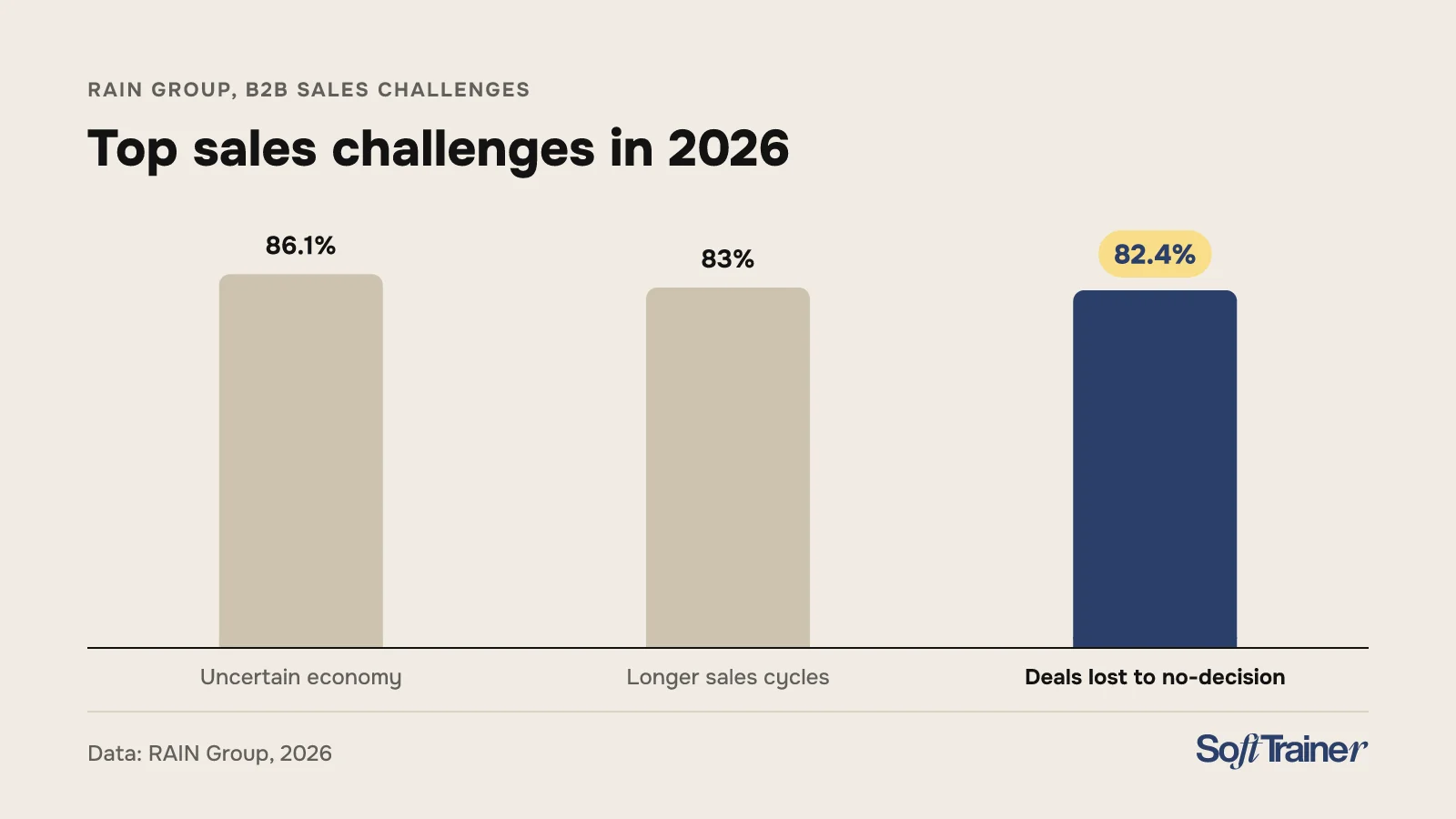
We agree that the phrase is not a refusal. That is why all 12 scripts are questions. The risk is the end of the call: in the Ringostat analysis, reps named no next step in 17% of all calls, and RAIN Group found that 82.4% of respondents name lost deals to no decision as a challenge in 2026.
How SoftTrainer trains this answer
In SoftTrainer, a rep talks by voice to an AI character in a situation from real work, and a team can build a scenario where the buyer ends the call with "we will think about it". The rep must find the reason and agree a date aloud.
The report gives a level for each competency, with the lines of the conversation as evidence. One cycle of assessment, practice and a new assessment takes 90 days, as the methodology describes.
What to do tomorrow
Open your CRM and find three deals where the last note says "will think" or "will come back". For each one, write which of the four reasons is most likely. Call one customer and ask the question of that group, then agree a date.
If the customer gets angry instead, see how to talk to an angry customer.
Questions and answers
What does it mean when a customer says "we will think about it"?
It is a decision to wait. The usual reasons are no urgency, another decision maker, a doubt about the result, or the price. One question shows which one it is.
What do you say when a customer says "let me think about it"?
Accept it, then ask one question that fits the reason, for example "What is the one thing that you still need to see to decide?" End the call with a date for the next step.
Does "we will think about it" mean no?
Not always. Gong Labs found no drop in win rates for deals where buyers said "I need to think about it". The deal dies when the call ends with no next step.
Sources
- Антон Петрухін: що робити, коли клієнт говорить «Дорого» і «Я подумаю» (Finance.ua, 12 вересня 2020)
- Межа: ШІ дослідив 50 тисяч розмов компаній з клієнтами, дослідження Ringostat (16 грудня 2024)
- Mary Flaherty: Selling in Economic Uncertainty (RAIN Group, 2026)
- RAIN Group: B2B Sales Challenges (research page, 252 respondents)
- Gong Labs: How to respond when buyers say "I need to think about it" (140,566 opportunities, 2020, updated 2026)
- Chris Voss on Deal Junky with Jeremy Harbour (YouTube)
- Сергій Герус: Чому клієнт каже «подумаю» навіть після того, як сам записався до вас на зустріч (YouTube, 9 серпня 2026)
- Kovalenko, R., & Rohovynska, K. (2026). The Soft Skills Measurement Gap. Zenodo.