Conflicts
Conversation after a conflict at work: the follow-up check
The joint meeting ends the argument, and the conflict can stay. One to two weeks later, check what the two people do in daily work, and agree one change and the date of the next check.
 Ruslan KovalenkoCo-founder and CEO, SoftTrainer
In short
- Plan the follow-up before the joint meeting ends. Put a date in both calendars.
- Check behaviour first. Who talks to whom, which rule holds, where work waits.
- Talk to each person alone first. Then a short joint check only if both are ready.
- If two checks change nothing, change the structure. Roles, owners or teams.
Ten days ago a support team lead ran a joint meeting with two senior agents. They had argued for weeks about who owns escalated refund tickets. They agreed on a rule: refunds over a set amount go to one of them, the rest to the other. Today both are polite, but they talk only in the ticket system and send the lead a note each time the rule is not clear.
This is the normal state soon after a conflict. The agreement exists, but the working relationship is not back yet. This article continues our guide to difficult conversations for managers and the plan for a conflict between two employees.
Many agreements fade without a follow-up
An agreement in the room does not mean a change at work. Researchers who studied 25 mediated workplace cases for Acas found that most ended in an agreement. In about half of the cases, the agreement did not hold.
The study by Saundry, Bennett and Wibberley (2013) names one reason: in most cases nobody followed up after the mediation. A practitioner in the study put the limit of a one-off meeting plainly.
I wouldn’t necessarily say that a one off day is going to do much other than open a can of worms and let you look at them on the table.
What to check one to two weeks later
Check what you can see. Feelings come back slower than behaviour, and a question like “Are you OK now?” gets a polite yes.
- Direct contact. Do they talk to each other, or only through you or a tool?
- The rule of the agreement. Does it hold in real cases, and where is it unclear?
- Waiting work. Do tasks between them wait longer than other tasks?
- The rest of the team. Do others still joke about it or take sides?
Run the follow-up talk in four steps
Talk to each person alone first, for 15 minutes. If both say the rule works, a short joint check is enough. If one of them is still angry, do not force a second joint meeting yet.
- Ask what works. “Which part of the agreement helped this week?”
- Ask where it breaks. “Show me one case where the rule was not clear.”
- Agree one change. Fix the rule: a clearer limit, a named owner.
- Set the next check. In a month, then close the topic if the work flows.
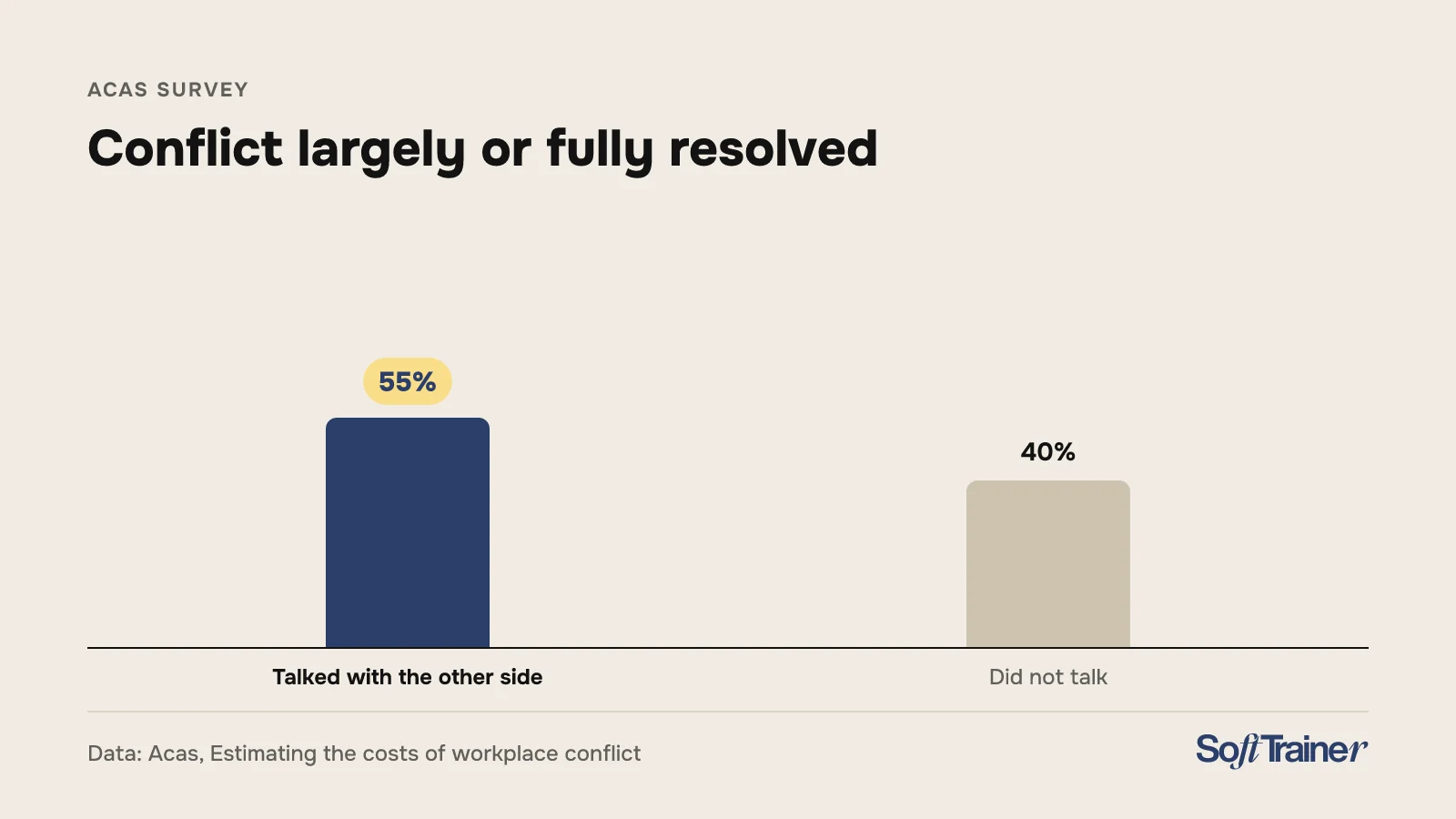
Talking seems to help. In an Acas survey of 2021, 55% of people who discussed the matter with the other side said that the conflict was largely or fully resolved, against 40% of those who did not. Acas calls this evidence tentative.
The opposite view: the conflict is in the structure
The consultant Liz Kislik argues that managers look at the two people when the cause is the structure around them: overlapping roles, unclear goals and decision rights. Then a talk with the two people changes little, because the structure brings the conflict back.
It seems unrealistic to blame individuals and to treat them as if they have sole responsibility for conflict, when as you can see, they're really only the tip of the proverbial iceberg.
We agree, and the follow-up is the place to test it. If the same rule breaks twice, the problem is probably in the role. Change the owner, the limit or the team.
What to do tomorrow
If you had a joint meeting in the last two weeks, put a 15-minute check with each person in the calendar now. Write down the four signs from the list and look for them before the talk. If voices rise, the moves of tension reduction help.
In our research with 130+ HR and L&D leaders (October 2024 to March 2026), about 21% said that what people learn does not reach their behaviour at work. We see the same risk after a conflict: the agreement is what people know, the follow-up shows what they do. The methodology explains how we measure a conversation skill again after 90 days.
Questions and answers
What should a manager do after a conflict between employees?
Put a follow-up in the calendar before the joint meeting ends. One to two weeks later, check behaviour: direct contact, the rule of the agreement and waiting work. Then talk to each person alone.
How long after a conflict should you follow up?
One to two weeks after the agreement, and again a month later. If the work flows after the second check, close the topic.
What if the conflict comes back after the agreement?
Look at the structure first: roles, owners and decision rights. If the same rule breaks twice, change it, or move the work between people or teams.
Do the two employees need to become friends again?
No. They need a working relationship: direct contact, clear owners and work that does not wait. Friendship is their own choice.
Sources
- Saundry, R., Bennett, T., Wibberley, G. (2013). Workplace mediation: the participant experience. Acas Research Paper 02/13
- Acas: Estimating the costs of workplace conflict (report, 2021)
- Liz Kislik: Why There’s So Much Conflict at Work and What You Can Do to Fix It, TEDxBaylorSchool (YouTube, 16 January 2018)
- Happy Monday, Марина Молчан: Конфлікти на роботі: 6 кроків до примирення команди (оновлено 24 березня 2026)
- People First Podcast, епізод 49: Як розрулити конфлікт: роль менеджера, медіатора (YouTube, 24 листопада 2025)
- Kovalenko, R., & Rohovynska, K. (2026). The Soft Skills Measurement Gap. Zenodo.