Wellbeing
How to talk to an employee about burnout: notice, ask, change the load
Start the talk before the person asks for it. Say what you saw, ask about the work, do not diagnose, and leave with one change to the workload that you make this week.
 Ruslan KovalenkoCo-founder and CEO, SoftTrainer
In short
- Talk early. When a person says that they are burned out, it started weeks ago.
- Describe, do not diagnose. Say what you saw with dates. Leave the medical words out.
- Ask about the work. Workload, time, fairness and support are the causes that a manager controls.
- Change one thing this week. Remove a task, move a date or take a meeting off the calendar.
A senior developer who used to answer code reviews in an hour now answers in two days. She skipped the last two retros. In the stand-up she says "fine" and nothing more. Her team lead thinks it is a motivation problem and plans a talk about results.
It is probably not a results talk. Make the work the subject of the talk. Burnout is one of the talks in our guide to difficult conversations for managers, and it is the one that managers start too late.
Burnout is a work problem that the manager can change
Burnout comes from the work, so the manager has real levers. The World Health Organization lists it in ICD-11 as an occupational phenomenon from chronic workplace stress that was not managed. It is not classified as a medical condition.
The scale is large. In a 2018 Gallup study of nearly 7,500 full-time employees, 23% felt burned out at work very often or always, and 44% felt it sometimes. Burned-out employees were 2.6 times as likely to look for another job.
The level has not dropped since. Newer Gallup data from March 2026 show that 31% of women and 23% of men who work full time in the US feel burned out very often or always.
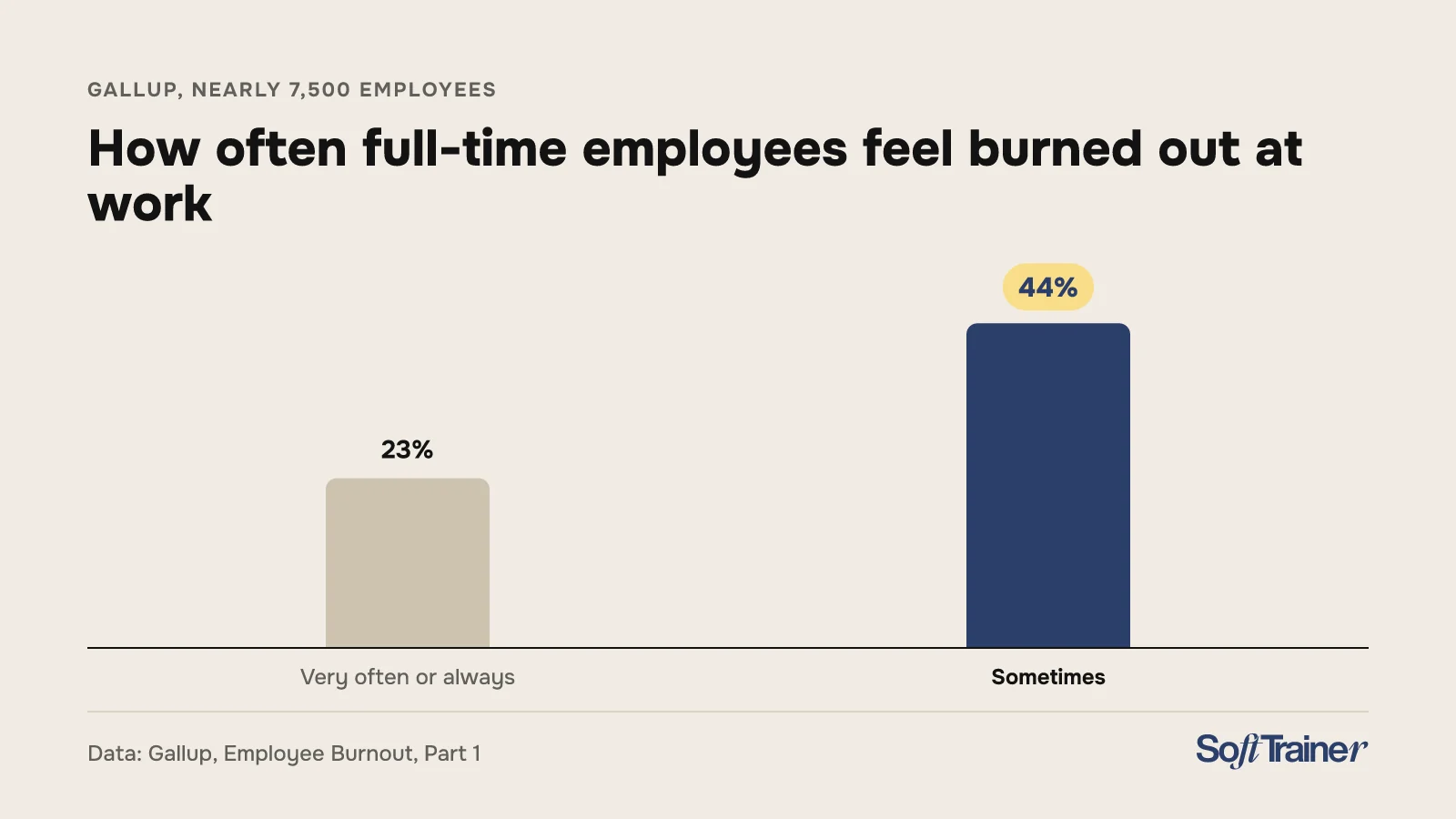
The same Gallup work names the causes: unfair treatment, an unmanageable workload, unclear expectations, little support from the manager and too little time. Each of them is a decision of the team, so each of them can change.
Start the talk before the person asks for it
Start when you see the same change for two or three weeks. People rarely name burnout early, because it sounds like a weakness. By the time they say it, it is worse than it looks.
Whatever they’re saying they feel today, they were probably feeling weeks ago, but today mustered the courage to talk with you about it.
Watch for a change that lasts, for example slower answers and skipped team rituals. Write down two or three with dates before the talk.
Carmen Paredes, a former executive and leadership coach, burned out twice. In her TEDx talk she says that the first time she recovered because her manager cared. The second time she had to leave her career. Her lesson for managers:
the best gift you can give your employees is to care about them Beyond kpis and metrics
A four-step plan for the conversation
Say what you saw, ask an open question, listen for the cause in the work, and agree one change. The talk takes 20-30 minutes in private. Keep targets and KPIs out of the talk.
- Say what you saw, with dates. "In the last three weeks, your reviews take two days, and you skipped two retros. I wanted to check in."
- Ask an open question. "How is the work going for you right now?" Then count to ten before you speak again.
- Look for the cause in the work. "When you go home, do you still think about work?" "What would you remove from your plate if you could?"
- Agree one change and a date. "I will move the reporting task to Max this week. Let us talk again on Thursday next week."
Do not use the words "depression", "anxiety" or "you need therapy". You are not qualified to diagnose, and a label closes the talk. If the person talks about health, point to the employee assistance programme or a doctor, and bring in HR.
The opposite view: wellbeing is not the manager’s job
The opposite view says that a manager should stay out of an employee’s wellbeing and leave it to HR and professionals. Sabina Nawaz, a CEO coach and the author of You’re the Boss, is quoted on this point in an Atlassian blog article.
Managers are not therapists, and they’re not trained as therapists.
Paredes goes further in the same talk: from 6:29 she argues that people burn out because of subconscious self-conditioning from childhood. In her view, the work environment is the trigger only. We agree with the limit, and that is why the plan above talks about the work only. The workload, the deadlines and the fairness of decisions belong to the manager. Jennifer Moss makes the same point in Harvard Business Review: yoga and resilience tips do not fix a workplace problem.
How SoftTrainer trains this conversation
In SoftTrainer, a manager practises a hard talk by voice with an AI character in a situation from real work. The manager says aloud what they saw, asks the open question and agrees one change and a date.
The report gives a level for each competency, with evidence from the conversation, and each practice run ends with one next step. The manager can run the talk again before the real one-to-one. You can try a hard conversation by voice.
What to do tomorrow
Add one question to each one-to-one this month: "What is one thing that takes your energy that I could change?" Write the answers down and act on one of them within a week.
If the burnout came after a run of missed dates, do not open with the dates. Have this talk first, and the conversation about a missed deadline later. If results also dropped, the performance improvement plan conversation shows how to keep the two talks apart. Do not let burnout end in a termination conversation that a change of the workload could prevent.
Knowing the four steps is not enough when the person says "fine" and looks away. In our research with 130+ HR and L&D leaders (October 2024 to March 2026), the theme "what people learn does not reach their behaviour at work" came up in about 21% of interviews.
Questions and answers
How do you talk to an employee about burnout?
In private, early, and about the work. Say what you saw with dates, ask how the work is going and listen for the cause. Agree one change to the workload and a date to talk again.
Should a manager say the word burnout?
You can use the word if the person uses it first. Do not give a diagnosis. Talk about what you saw and about the work, and point to professional help if the person talks about health.
What if the employee says everything is fine?
Accept the answer and keep the door open. Say what you saw once more and offer one concrete change anyway. Check in again within two weeks, because people often open up at the second talk.
When should a manager involve HR?
When the person talks about a health problem, when the workload cannot change inside your team, or when burnout leads to a formal performance process. Bring the facts and the dates of your talks.
Sources
- World Health Organization: Burn-out an "occupational phenomenon": International Classification of Diseases (28 May 2019)
- Gallup: Employee Burnout, Part 1: The 5 Main Causes
- Gallup: Women Show Stronger Employee Engagement Amid Higher Burnout (7 March 2026)
- E. Beth Hemphill: Uncomfortable (but Necessary) Conversations About Burnout (Gallup, 6 December 2022)
- Jennifer Moss: Burnout Is About Your Workplace, Not Your People (Harvard Business Review, December 2019)
- Atlassian: How to better support your team without becoming their therapist (quotes of Sabina Nawaz)
- Carmen Paredes: 5 questions to help leaders prevent employee burnout, TEDxBorrowdale (YouTube, 29 April 2024)
- DOU: 38% айтівців відчувають вигорання. Хто вигорає найчастіше й до чого тут гроші (2026)
- Happy Monday: «Я більше не можу»: що це - вигорання, нудьга чи ви переросли свою роботу? (Анна Саєнко, 19 листопада 2026)
- Ореста Шпак: Хронічний стрес, вигорання і втома команди: як керівнику втримати людей і робочі процеси? (Фінансова Академія Актив, YouTube, 21 травня 2026)
- Kovalenko, R., & Rohovynska, K. (2026). The Soft Skills Measurement Gap. Zenodo.