Performance
Performance improvement plan conversation: how to open a PIP that helps
A performance improvement plan conversation names the gap with numbers and finds the cause. It ends with a written plan: one goal, one kind of support and a check date in 30 days.
 Ruslan KovalenkoCo-founder and CEO, SoftTrainer
In short
- Name the gap with numbers. The expected result, the real result, the period.
- Agree what good looks like. Many gaps start with an expectation that was never said.
- Find the cause before the fix. Skill, workload, clarity or a personal reason need different help.
- End with a written 30-day plan. One goal, one kind of support, a check date. A formal PIP comes only if this plan does not work.
Here is an example. An account manager closed 3 renewals this quarter. The team target was 8, and the others closed 7 to 10. His manager has seen the numbers for two months and said nothing. Now the quarterly review is next week.
Do not save it for the review. Have the talk now, and open an improvement plan that you check in 30 days. This talk is part of our guide to difficult conversations for managers.
A performance improvement plan is a written goal, support and a date
A performance improvement plan (PIP) is a written agreement for an employee whose results are below the standard. It names the goal, the support from the manager and the date of the review. The first conversation decides whether the person sees the plan as help.
Start with an informal plan. Acas, the UK workplace advisory service, suggests a formal PIP when informal steps do not work. The two plans differ like this:
| Informal 30-day plan | Formal PIP | |
|---|---|---|
| Purpose | Help the person reach the standard | Help, and a record that help was given |
| Who takes part | The manager and the employee | The manager, the employee and HR |
| On paper | A short note after the talk, in the words of the person | A written plan with the goal, the support and what happens if the result does not change |
| If the result does not change | A formal plan | The procedure of your company and local law |
Name the gap with numbers
Start with the expected result, the real result and the period. "You are not proactive" gives the person nothing to change. "The target was 8 renewals in the quarter, and you closed 3" gives a clear starting point.
Then check that the target was clear. As of August 2026, only 46% of U.S. employees say that they know what is expected of them at work, according to Gallup. Ben Wigert and Sangeeta Agrawal of Gallup describe what the best managers do about it.
The best managers discuss responsibilities and performance goals with their employees and collaborate with them to ensure that expectations are clear and aligned with those goals.
Find the cause before you choose the fix
A low result has a cause, and each cause needs a different fix. Acas says that employers should first try to understand why the problem exists. Ask, then listen.
| Cause | What you hear | Support for 30 days |
|---|---|---|
| Skill gap | “I don’t know how to handle the pricing objection.” | One practice session and one joint call each week. |
| Unclear expectation | “I thought my job was new logos, not renewals.” | Write the goal and the measure together. |
| Too much work | “I also cover the onboarding of two clients.” | Move one task to someone else for the month. |
| Personal reason | “Things at home are hard right now.” | Adjust the plan and bring in HR support. |
If the person describes exhaustion, stop the performance talk. Talk about the workload and the rest first, and come back to the numbers later.
Agree a 30-day plan and write it down
A 30-day plan has one goal, one kind of support and a check date. We use 30 days: four weekly support sessions give enough calls to see a trend. Write it in the words of the person, and send it after the talk.
- Say the gap. "The target was 8 renewals. You closed 3. The team average is 8."
- Ask about the cause. "What made this quarter hard for you?"
- Agree the goal. "By 20 December: 4 renewal calls a week, with notes in the CRM."
- Agree the support. "Every Tuesday we prepare the hardest call together."
- Set the check. "On 20 December we look at the calls and the renewals together."
On day 30, close the plan, extend it once, or move to a formal PIP with HR.
John Amaechi, the author of The Promises of Giants, argues that this kind of talk can be learned like any other process.
Feedback is simple. It’s a learnable, semi-scripted process that, if followed in almost any situation, will lead to behavioural change, personal and professional development, and enhanced outputs.
The opposite view: improvement plans rarely work
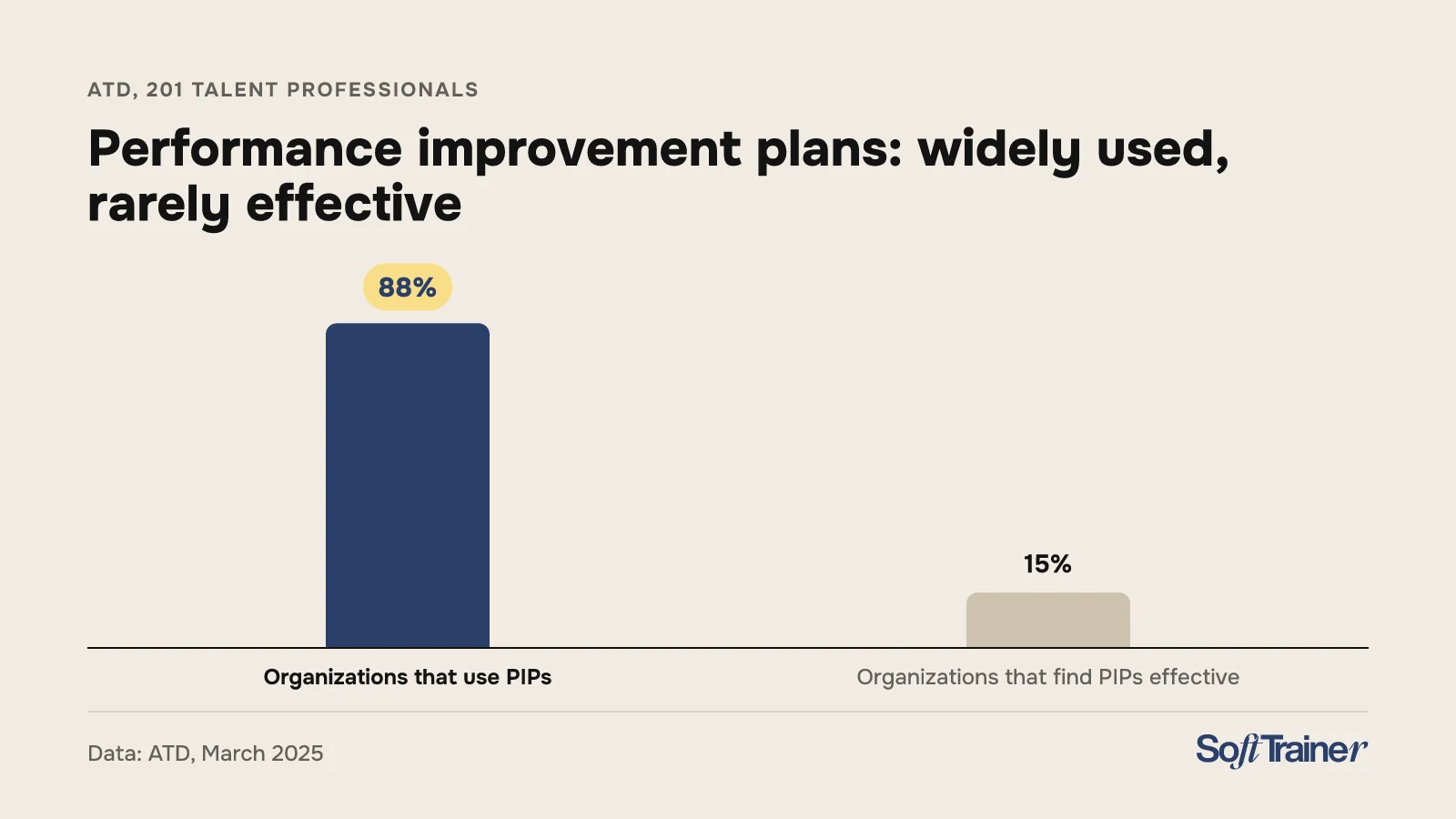
The case against: few organizations find improvement plans effective. In a 2025 ATD survey of 201 talent development professionals, 88% of organizations used performance improvement plans, but only 15% found them effective.
Our answer: the 30-day plan comes before any formal process, and its goal is to help. Say it plainly: "My goal is that you hit the target next month. Here is what I will do for it." If the talk becomes formal, bring in HR and keep a record of each talk.
In our research with 130+ HR and L&D leaders (October 2024 to March 2026), about 30% said that feedback at work is too rare and too subjective. In their view, it does not change behaviour. Feedback without a development path was among the practices that did not work.
How SoftTrainer trains this conversation
In SoftTrainer, a manager practises a hard talk by voice with an AI character in a situation from real work. The manager says the gap aloud, asks about the cause and agrees the next step.
The report gives a level for each competency, with evidence from the conversation. Each practice run ends with one next step, so the manager can run the talk again before the real meeting. You can try a hard conversation by voice.
What to do tomorrow
Before the talk, write three lines: the expected result, the real result and the period. Add one question about the cause. If the person is usually your strongest, read negative feedback to a strong employee too.
If the gap is one missed date, a shorter talk is enough: the conversation about a missed deadline.
Questions and answers
How do you start a conversation about low performance?
With the numbers: the expected result, the real result and the period. Then ask what made the period hard. Keep adjectives about the person out of the first minutes.
How long should a performance improvement period be?
For an informal plan, 30 days is a practical start: one goal, one kind of support and one check date. A formal plan can be longer. HR and local law set its rules.
What if the employee disagrees with the facts?
Show the source of the numbers and ask what you are missing. If the target was never clear, agree it now and start the 30 days from today.
When does a low performance talk become formal?
When the informal plan did not change the result. Then bring in HR, give the plan in writing and say what happens if the result does not improve.
Sources
- ATD: Organizations Have a Long Way to Go to Master Performance Management (press release, 12 March 2025)
- Acas: Problems with an employee’s performance
- Gallup: Indicator: Employee Engagement (Q01, Knowing what’s expected)
- Ben Wigert and Sangeeta Agrawal: Employee Burnout, Part 1: The 5 Main Causes (Gallup, 12 July 2018)
- John Amaechi: Withheld feedback costs you your best people (Giant! with John Amaechi, Substack, 1 March 2026)
- Сергій Доброжанський: Як проводити зустріч 1:1, коли працівник втрачає мотивацію (DOU, 20 жовтня 2026)
- Forbes Україна: Як надати негативний фідбек. Шість правил від CEO Intellias, Nestle, Novus і Universal Bank (21 жовтня 2024)
- Kovalenko, R., & Rohovynska, K. (2026). The Soft Skills Measurement Gap. Zenodo.