Conflict
Conflict resolution training: what works and how to check the result
Conflict resolution training works when managers practice real conversations under pressure and you measure the skill before and after. A framework on slides changes what managers know. Their behavior in a conflict stays the same.
 Ruslan KovalenkoCo-founder and CEO, SoftTrainer
In short
- Train the line manager first. The manager is the first person who can stop a conflict.
- Practice beats a framework. A manager needs repeated conversations with pushback.
- One skill at a time. Choose one conversation type for a quarter.
- Check after 90 days. The same scenario and the same scale show the change.
An HR director buys a two-day conflict management course for 30 managers. Each manager gets a binder with a five-step model. Six months later the number of formal grievances is the same, and the HR team still leads each hard talk.
The course taught a model, and the managers needed a skill. This article shows what a conflict resolution training must have and how to check the result. It is part of our guide to difficult conversations for managers.
Many managers get no training for conflict
Many organizations expect managers to resolve conflict and do not train them for it. In CIPD research of 2024, 30% of 2,009 UK employers said that they give no training in people management skills. In a separate CIPD survey of 5,496 workers, only 36% of those who had a conflict said that it was fully resolved.
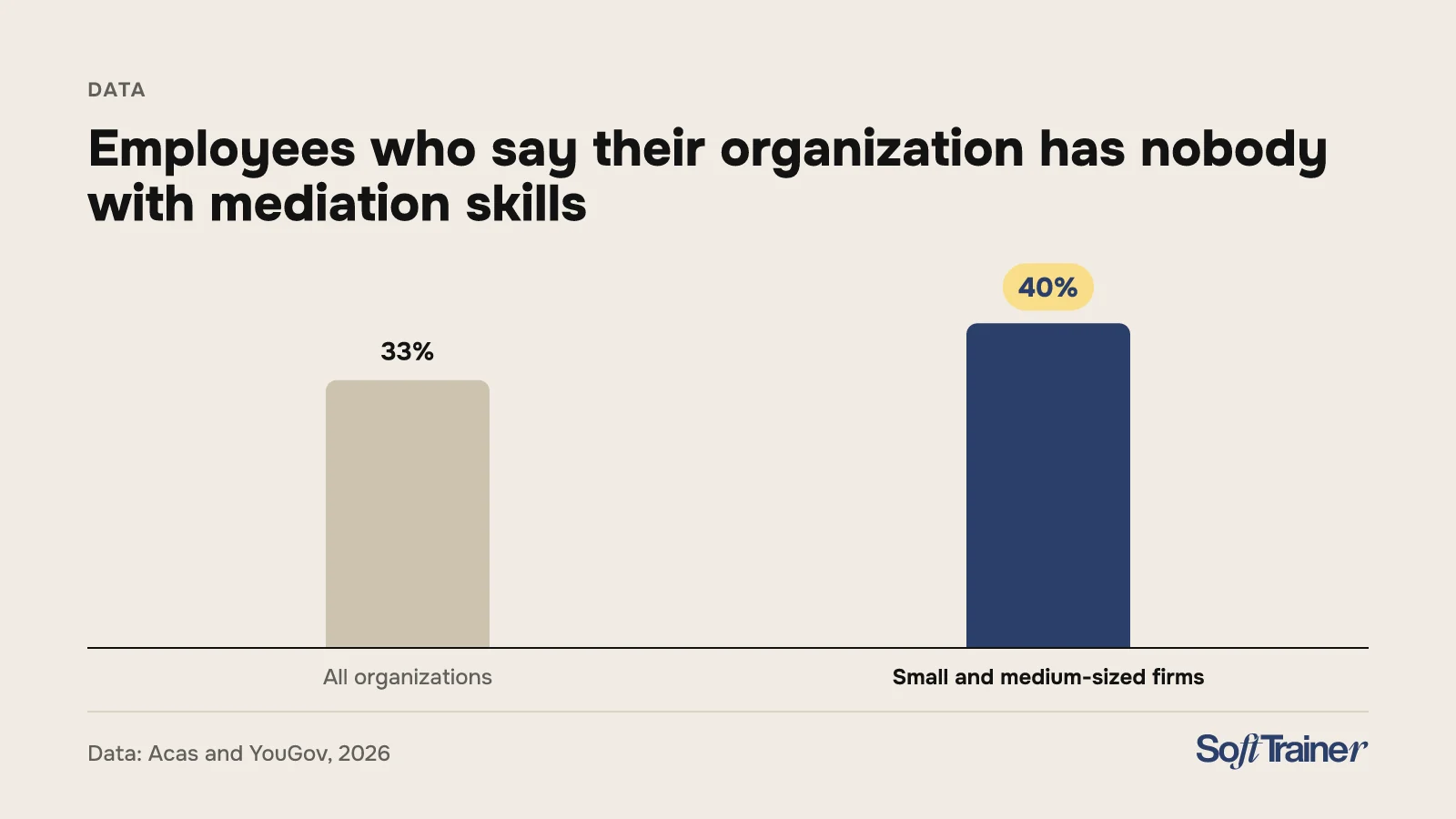
Acas found a similar gap. In its survey of 1,000 employees in Great Britain by YouGov in February 2026, 33% said that their organization has nobody with the mediation skills to resolve a workplace conflict. In small and medium-sized firms the share was 40%.
Pete Colby, the managing director of the consultancy Pragmatism, describes the result in People Management.
This starts with HR helping managers who are rarely trained in the art of real conversations, but are often criticised for not dealing with issues
Conflict resolution training needs five things
A training that changes behavior has five parts: one target conversation, a standard, a baseline, practice with pushback and a new check. Most courses have only the standard, in the form of a model. Without practice and a check, a course is information.
- One target conversation. Choose the conflict that costs your company most, for example a dispute between two team members about responsibilities.
- A standard of behavior. Write what a good conversation sounds like. Use the six conflict resolution skills of a manager as the base.
- A baseline. Each manager has the same conversation before the training, scored with one scale.
- Practice with pushback. Short conversations each week in which the other side disagrees, interrupts or stays silent.
- A new check after 90 days. The same scenario and the same scale. The difference is the result.
Our research supports part 4. In 130+ interviews with HR and L&D leaders from October 2024 to March 2026, about 21% said that what people learn does not reach their behavior at work. Parts 4 and 5 close that gap.
Practice is the part that most courses skip
A manager learns to resolve a conflict in the conversation itself. A model helps the manager to prepare, and it does not help in the moment when the employee says "that is not fair". Only repeated practice builds that reaction.
Jeremy Pollack, a social-organizational psychologist and the founder of Pollack Peacebuilding Systems, names this as the usual fault of conflict courses.
Too often, conflict training focuses on providing a framework or a set of communication techniques without giving managers enough opportunity to use them in realistic situations.
Pollack recommends role play, case studies and simulations built on the situations that managers really meet. A good scenario for the first month is the conversation with two employees in conflict. For the reaction under pressure, add de-escalation as a skill of a manager.
The opposite view: a trained manager is not a mediator
A trained manager has a limit. Acas defines mediation as a process that an impartial mediator leads, a person who does not take sides. A line manager is part of the team, has a history with both people and decides their pay.
Kevin Rowan of Acas describes the purpose of mediation.
It is not about judging who is wrong or who is right. It is about bringing people in a disagreement together to agree on a way of working together.
We agree that some conflicts need a neutral third person: harassment, a conflict in which the manager is a side, a conflict that already reached a grievance. Training covers the stage before that. A manager who can lead the early, informal conversation sends fewer cases to mediation.
How SoftTrainer trains conflict resolution
In SoftTrainer, each manager talks by voice to an AI character in a situation from real work. In one public scenario the manager tells Daniel Mercer, a senior engineer, that his peer got the promotion. The manager must say the decision plainly, own what was promised, find out what is at stake and agree a path.
The first assessment is the baseline: one scenario and one scale for all managers, ten minutes for each person. Then managers train on practice simulations, and each run ends with one next step. After 90 days a new assessment shows the change for each competency. Our methodology describes the cycle.
What to do tomorrow
Take the plan of your next conflict training and look for three things: the target conversation, the hours of practice and the check after the course. If one of them is missing, ask the provider how they will add it. If two are missing, you are buying a lecture.
Questions and answers
What is conflict resolution training?
It is training that teaches managers and employees to lead a disagreement to a decision that both sides accept. A good programme has a standard of behavior, practice in realistic conversations and a check of the skill before and after.
Does conflict resolution training work?
It works when people practice the conversation and you measure the skill. A course that gives only a model changes knowledge, and knowledge alone does not reach behavior at work.
Who needs conflict resolution training first?
Line managers. They see a conflict first and can stop it with an early, informal conversation. Formal grievances and mediation start later and cost more.
How do you measure the result of conflict resolution training?
Give each manager the same realistic scenario before the training and again after about 90 days. Score both with one scale and compare the level of each competency. Add the number of formal grievances as a business measure.
Sources
- CIPD: Only around a third of employees feel the conflict they experienced at work has been fully resolved (2024)
- Jeremy Pollack: Training Leaders to Manage Conflict on Their Teams (Training Industry, 13 November 2026)
- Acas: New Acas survey reveals widespread gaps in workplace mediation skills (25 June 2026)
- Islam Soliman: What should HR do if workplace rivalries get out of hand? (People Management, 12 November 2026)
- Маріанна Хоніна: Чому гарний конфлікт кращий за штучний мир, або Як правильно конфліктувати на роботі (Happy Monday, 1 липня 2024)
- Олена Коваль: Що робити, якщо менеджер токсичний, і як конфлікти вирішують в українських ІТ-компаніях (DOU, 30 липня 2024)
- Kovalenko, R., & Rohovynska, K. (2026). The Soft Skills Measurement Gap. Zenodo