Conflict
Conflict resolution skills: the 6 skills of a manager and how to train them
Conflict resolution skills are six things that a manager does in a disagreement. Notice it early, hold your reaction, listen, find the interest, say the hard thing and agree a date.
 Ruslan KovalenkoCo-founder and CEO, SoftTrainer
In short
- Six skills, each one a behavior. You can see and hear each skill in a conversation.
- The first skill is timing. A manager who talks at the first sign has an easy conversation.
- Employers rate their conflict handling higher than employees do. In CIPD data, 70% of employers trust their procedures, and 36% of employees say their conflict was fully resolved.
- Skills grow in practice. A manager needs realistic conversations and a check with one scale.
A team lead with eight engineers sees that two of them stopped talking in the stand-up. She waits for three weeks. Then one of them asks to move to another team. The lead knew what to do, and she did not do it in time.
Conflict resolution is a set of skills, and each skill is a behavior that you can train. This article lists six for a manager. It is part of our guide to difficult conversations for managers.
Conflict resolution skills are six behaviors
Conflict resolution skills are the behaviors that help two sides of a disagreement to reach an agreement and keep working together. For a manager there are six. You can see each skill in a conversation, and train it.
| Skill | What the manager does | Phrase |
|---|---|---|
| 1. Notice early | Starts an informal talk at the first sign of a pattern | "I see that you two stopped reviewing each other’s code. What happened?" |
| 2. Hold the first reaction | Pauses and names their own emotion before the answer | "Give me a second. I want to answer this well." |
| 3. Listen to each side | Talks to each person alone and repeats what they heard | "You feel that your estimate was ignored. Is that right?" |
| 4. Find the interest | Asks what the person needs behind the demand | "What would a good result look like for you?" |
| 5. Say the hard thing directly | Describes the behavior, with no label for the person | "In the last two reviews you rejected the change with no comment." |
| 6. Close with an agreement | Fixes who does what, and sets a date for a check | "We meet again on the 15th and see how this works." |
Employers and employees see conflict differently
Organizations think that they resolve conflict well, and their people do not agree. In CIPD research of 2024 with 2,009 UK employers and, in a separate survey, 5,496 workers, 70% of employers said that their procedures for conflict are effective. Among employees who had a conflict in the last 12 months, only 36% said that it was fully resolved.
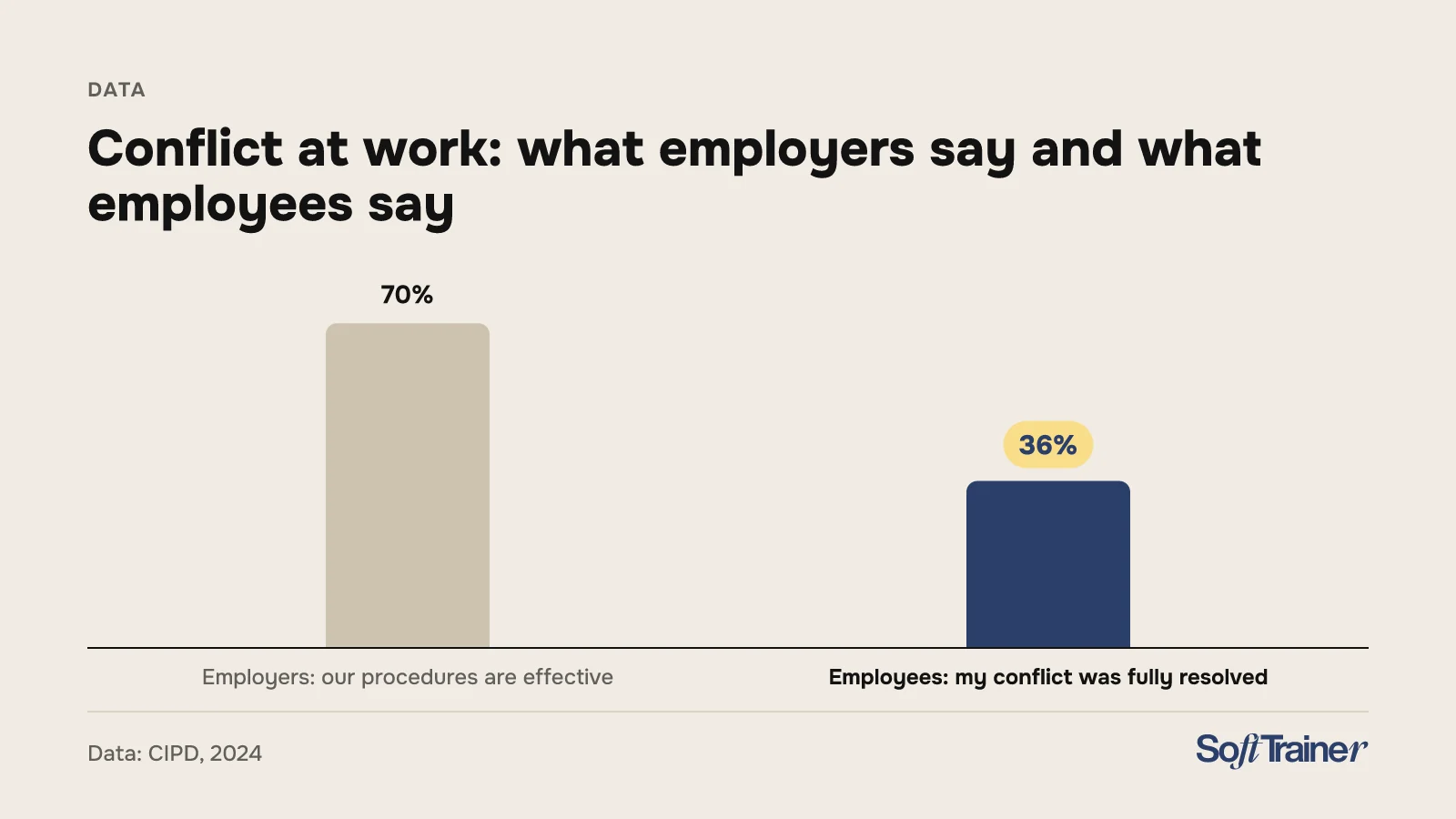
The same CIPD data shows where the gap starts: 49% of employers admit that line managers can cause conflict in their teams. A procedure starts after the conflict has grown. The six skills work before that.
Skills 1-3 keep the conversation possible
The first three skills are about the manager, and they come before any solution. The manager notices the conflict, controls the first reaction and listens. If one of them is missing, the two sides defend themselves and the facts stay hidden.
Jeremy Pollack, a social-organizational psychologist and the founder of Pollack Peacebuilding Systems, describes what managers must train. His list is close to skills 3 and 5.
Managers should practice listening without immediately rebutting, acknowledging a concern without automatically agreeing with it, and setting clear expectations when behavior needs to change.
For the conversation with two people, use the order of three conversations in a conflict between two employees. For skill 2, read about de-escalation as a skill of a manager.
Skills 4-6 lead to an agreement
The last three skills turn a calm conversation into a result. The manager finds what each side needs, says the hard thing in plain words and fixes the agreement with a date. A conflict without a check date comes back.
Skill 5 is a feedback skill, and feedback is a known weak point. In our 130+ interviews with HR and L&D leaders from October 2024 to March 2026, about 30% said that feedback is too rare and too subjective to change behavior.
After the agreement, plan the conversation after a conflict. For HR: what a conflict resolution training must have.
The opposite view: teams need more conflict
Some experts say that the problem of most teams is too little conflict. Liane Davey, an organizational psychologist and the author of The Good Fight, calls the avoided discussions "conflict debt". In her view, each discussion that a team avoids adds to the debt, and the team pays interest on it.
When I work as an advisor to executive teams, the most common team effectiveness problem I see is too little conflict.
We agree, and the six skills fit her view. Skill 1 opens a disagreement that people hide. Skill 5 says the thing that nobody says. Resolution means that the two sides reach a decision, and silence is the opposite of that.
How SoftTrainer trains conflict resolution skills
In SoftTrainer, a manager practices the conversation by voice with an AI character. In one public scenario the character is Naomi Rodriguez, a product manager. She promised the CEO a Friday launch without the team, and the payments code can charge customers twice.
The manager must credit her win, explain the risk in business terms and agree a joint plan. These are skills 4, 5 and 6 in one conversation. The report gives a level for each competency with evidence from the conversation, and each practice run ends with one next step. You can try a conversation for free.
What to do tomorrow
Name one tension in your team that you noticed and did not discuss. Talk to each person alone this week, and start with skill 3: repeat what you heard before you give your view. Write down the agreement and the date of the check.
Questions and answers
What are the main conflict resolution skills?
For a manager there are six: notice the conflict early, hold the first reaction, listen to each side, find the interest behind the demand, say the hard thing directly and close with an agreement and a date.
Can conflict resolution skills be learned?
Yes. Each skill is a behavior that you can see in a conversation, so you can practice it and check it. Reading about the skills is not enough: a manager needs realistic conversations with pushback.
Which conflict resolution skill matters most for a manager?
The first one, timing. A talk at the first sign of a pattern is short and informal. The same talk three weeks later needs all the other skills and often HR.
Is the goal of conflict resolution to stop the conflict?
The goal is a decision that both sides can work with. A team that hides its disagreements has a larger problem than a team that argues. The skills help people to disagree and still reach an agreement.
Sources
- CIPD: Only around a third of employees feel the conflict they experienced at work has been fully resolved (2024)
- Jeremy Pollack: Training Leaders to Manage Conflict on Their Teams (Training Industry, 13 November 2026)
- Liane Davey: Conflict Debt (19 November 2017)
- Маріанна Хоніна: Чому гарний конфлікт кращий за штучний мир, або Як правильно конфліктувати на роботі (Happy Monday, 1 липня 2024)
- Саша Фідкевич: Як впоратися з конфліктами в команді: поради менеджерам (Happy Monday, 19 серпня 2022)
- DOU: Чверть лідів звільнили через конфлікт з керівництвом. Аналітика про скорочення айтівців (12 травня 2025)
- Kovalenko, R., & Rohovynska, K. (2026). The Soft Skills Measurement Gap. Zenodo